Showing posts with label arts and crafts. Show all posts

Friday, July 27, 2012

Nursery Rhyme Yoga


Hey Diddle Diddle
the Cat (pose) and the fiddle,
The Cow (pose) jumped over the (half) Moon (pose).
The little (downward and upward) Dog (pose) laughed to see such sport,
and the dish ran away with the spoon.

And that is just what we did. Using a nursery rhyme book with illustrations, we recited the rhyme. Then, I introduced each pose as we recited the poem. I would ask the group questions like What was that animal that played the fiddle? or What was it that the cow jumped over? Upon their responses, I would introduce the next pose. After learning them all, we recited the rhyme together incorporating the poses.

For our yoga game,  I introduced each group to the yoga cube. Cubes are a great tool for getting little ones to get moving. Each side of the cube can have a different movement, or in this case, yoga pose. Each student is given an opportunity to shake and throw the cube into the center of the circle. That alone gets children moving! Whatever the cube lands on is the movement or pose we all do together.

I love cubes for creative movement, but they are also useful for songs, all about me questions, or simply turn taking skills. I have been decorating cube shaped tissue boxes for mine, however, they are not perfectly cubed. This presents an issue as it tends to favor certain sides over others. In the Nursery Rhyme Yoga class, it meant we did a lot of downward dog!

I think next time I need to rework my cube a little bit before decorating.

Thursday, June 21, 2012

Animal Masks and Movement

After two months on hiatus from foot surgery, I am finally back in the classroom! This week, I kicked off Story Story Dance with animal masks and the book Rumble in the Jungle by Giles Andreae. This book introduces many different animals, but I focused on the ones that I actually had masks for. This worked out great because if I had done all the animals, this would have been an hour long class. As it was, this class went over my allotted half-hour slot and took about forty-five minutes. Luckily, the teachers were great and happy for the extended class considering the kiddos would have shortened outside time due to the heat. Sometimes things just work out.

The masks were very simple, made out of animal face paper plates from the super market and tongue depressors for holding. I got this idea from a yoga teacher I worked with who used the plates in her children's yoga class to help children embody animal poses.


For this class, I read the short poems about each animal from the story and students explored smaller movements in their sitting positions.  After the story, we created a big circle with movement space in the center. Every student was given a mask and each animal had their own music. I used short musical compositions from a pre-ballet music selection. In partners, students came to the center of the circle and explored the larger animal movement.

As always, the children surprise me. The children seemed to love taking their masks and scaring the children in the outer circle and the children in the outer circle seemed to love getting scared! After every set of animals had a turn in the center, we went to the animal dance party, where all the animals dance together and the children become any animal they want to be.

In the beginning of the story, the narrator introduces the animals as waking up in the jungle and the end of the story, the animals go to sleep. So of course we ended class with all the animals falling asleep in the jungle. The fake snoring was hilarious! I traded masks for stickers and ended class. It's great to be back!

Thursday, April 19, 2012

Shaker Bottles and Math Foundations


Over the last few weeks, I have been saving and collecting various sizes and shapes of water bottles. I made enough for every student to have one during the latest story dance class. First we read an alphabet book that also features colors. We reviewed the colors before I handed out the shaker bottles. 

With shaker bottles in hand, I led the kiddos through a movement exploration exercise that explored location words - we shook the bottles in front, above, behind, to the side, down low,  and in between our legs! Then, of course, we got to free dance with them. Not only was this a fun, kinetic exploration on spatial awareness, but these words and concepts are also foundational math skills. 

We continued with our math skills at the end of class through bottle color-grouping and matching exercises. I encouraged students to find other students who's bottles were a similar color to their own bottle. For our cool down, I laid out different color felt squares. Then I called on students one at a time to bring up their bottle and put it on the corresponding color square (apparently I need more red bottles!). This part of the class also elicited a great discussion with the children about colors. For example, water in one bottle was a little bit blue and a little bit green - which square should it go on?

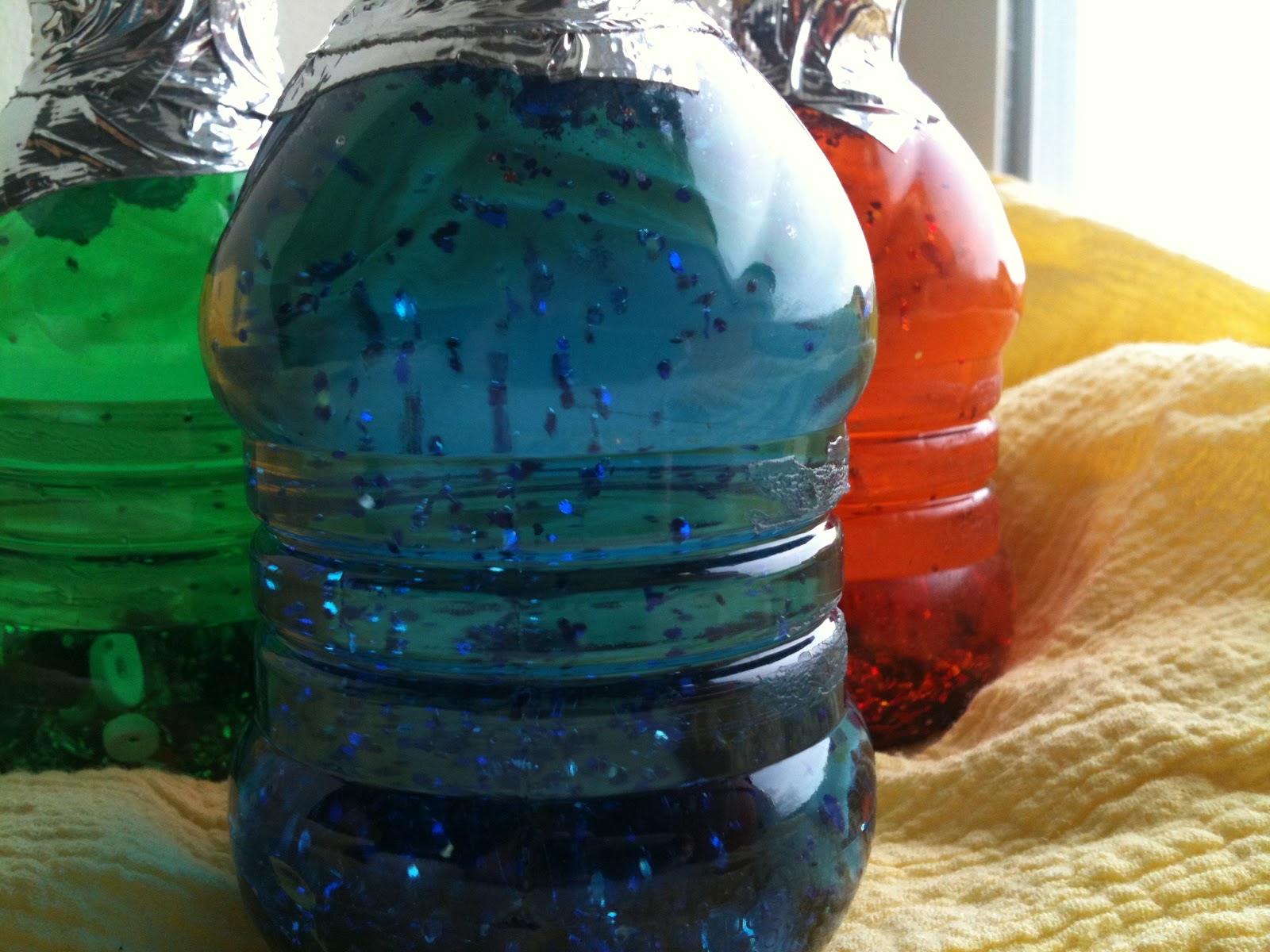
Young children are often mesmerized by the swirling objects inside the bottle. The ones I made also include letters of the alphabet, words, and fake fruit! Because the bottles also have some weight to them, the children are getting a good work-out, keeping their bodies healthy and strong while dancing, moving, playing, and learning.


 Making Shaker Bottles!

First, save a bunch of water bottles.


Then, make a trip to the local craft store for supplies - don't forget the food coloring and corn syrup from the grocers.


Then, go to town!


Tuesday, December 27, 2011

Polar Bear Cubs


For today's story dance class, we explored polar bear movement using fabric and a movement cube. We did our usual warm-up and then, instead of passing out the story squares, I laid out blue and white fabric and tulle. The children snuggled up on the "snow and ice" as we read My Little Polar Bear by Claudia Rueda. The story is simple and sweet. It is guided by the cub's curiosity to his mother about being a polar bear and we get to find out what polar bears like to do.

These same and other cub movements are reflected on my polar bear movement cube. This was constructed from a cube shaped tissue box, construction paper, and six polar bear movements I got from the Clifford magazine by Scholastic. I covered the tissue box with blue construction paper, then put a polar bear cub movement photograph with simple text, on each side. Each movement is labeled with a number and a sentence with a key word in it.

We reviewed each of the six movements then started the game. Each student took a turn to roll the cube into the "snow and ice," which I placed in the center of our circle. We acted out the movements each person rolled. Then I removed the fabric and let students explore these movements in free space as I narrated. I ended this guided imagery with everyone "curled" up (movement #6) and covered them with the fabric. This was their delight! Children love fabric, it can become anything. The children enjoyed playing under the fabric and acting like polar bear cubs in the snow. It was great.

Next, students lined-up for polar bear jumps. The white fabric acted as the snow pile, students jumped over it one at a time to the Nutcracker while I hit the tambourine.

Today's book invited a great movement class. I was looking for a winter or snow themed book when I came across the polar bear book and it all came together. I remembered I had a polar bear movement cube and when I couldn't find it - I made another one!

Movement cubes are great classroom tools. You can make them about anything and connect language and movement to pretty much any theme, you just need to get a little creative.

Saturday, December 3, 2011

"Peaceful Piggies" Yoga Characters

"Peaceful Piggy" Flann
 The kindergarten and pre-k classes did in fact enjoy the masks. They were a little too big, but we rolled with it. The kids thought they were silly and fun. I would read them a page from the book Peaceful Piggy Yoga by Kerry Lee Maclean (also in book recommendations!), then talk about the peaceful piggy in the illustration. I brought different props to go along with each piggy character. Two students would come up and become those "peaceful piggies" and demonstrate the pose for the class. The format worked really great, especially for the smaller pre-k group. For the larger kindergarten class,  we only had time for half of the book; I will do the second half of the book during our next class.

I brought back the ukulele and did Yoga Freeze Dance for our dance party. I encouraged the students to incorporate movements of the different characters and poses we had explored in the book. The end of class dance party varies each week. Sometimes we freestyle, sometimes we freeze dance with special poses, sometimes we play Magic Soup. The rules of the dance party may change, but I always leave time for the dance party; it wouldn't be story story dance without it!

I have not yet done peaceful piggies with the preschoolers. I think the format will have to be a little different and more contained. I think I will leave out the masks, but use the character props, and have everyone pretend to be peaceful piggies. I am pretty sure this group will be able to get into piggy character without the assistance of a mask. I'm still exploring ideas for this one.

I am also looking forward to the second half of Peaceful Piggies with the pre-k and kindergarten. They all seemed to enjoy taking turns being different characters and getting-up in front of the group.


"Peaceful Piggy" Jack in Tree Pose

Monday, November 14, 2011

Masks, Yoga, and Cool-Downs.

Sometimes when I am planning a class, it happens all it once. I get a creative surge and I just have to go with it and it completely consumes all my thoughts. Sometimes that happens the day before the class I am going to teach, like today.

I was thinking about building-off of last week's yoga book with Peaceful Piggy Yoga by Kerry Lee MacLean (read more about it in book recommendations). I originally wanted to bring in a stuffed animal pig to embody "peaceful piggy," but on the day I went to search for one, I came up empty handed. Now here I am the day before the class with no little piggy to bring. So I start rummaging. Because I have been doing this for 10 years, I have accumulated many odd things, because in the mind of a drama teacher - I could use this one day! Today, that day came.

I pulled out one of my "bins-o-things" and what do I see staring back at me? Two pig masks that I made years ago! yes! These were prototype masks, but perfectly usable. They are made from a soft pink foam and already cut to shape. I added the noses, and some features with pink felt, to try to soften them up (pig masks are a little creepy, but hopefully in the context of the book, it will all go ok). As I continued to rummage, I found enough other props so that the peaceful piggies can get into their characters that appear through the story. For instance, I have kerchiefs for the cowboy peaceful piggies, I have fancy waist wraps for the ballerina peaceful piggies (in lieu of tutus), and I have fancy scarves for the movie star peaceful piggies. Throughout the book,  I will call up two students at a time to put on the peaceful piggy mask and accompanying costume pieces, and teach the class the pose.

And then we end class with a dance party of course! Since yoga freeze dance went so well and we are still on this yoga theme right now, I will probably end with that.  After the dance party, I will have them do "corpse pose" from the book. Having students lie down on their backs at the end of physical activities like this is good to help them calm down and breath properly.

When I was training with the teachers at Dell'Arte, one of my mentors ended her elementary aged drama classes with "Graveyard." In this game, everyone lies down on their backs and they cannot move. If you move, even a subtle inch, she would go over to the student and tap them out. This goes on until there is one (or two) students left and they "win." Some kids would have total meltdowns if they got tapped out. I eventually took this idea and reshaped it into a different game for preschoolers, I call the "People Garden."

In the People Garden, everyone lies down on their backs and creates pathways using their bodies. Each student has a turn to "wake-up" and walk through the garden paths as anything they want to be - a butterfly, a cat, a train, a tiger, once a kid wanted to be a roller coaster. They walk all through the garden, they have their moment, they have all the attention, then tap the foot of someone else; they stand up and become whatever they want to be and the other student lies down in their spot. I love this end of class cool-down, but it is time consuming. There is no rushing the garden, so it is something that has to be planned for.

I am very curious how the kids will react to the masks tomorrow. My prediction is that some will love it and some are going to be like "no way," and hopefully, no one will be terrified and cry
(fingers crossed!).

Tuesday, October 25, 2011

First Class

Today I led my first groups integrating the props into The Little Old Lady Who Was Not Afraid of Anything by Linda Williams. My first group was 18 kindergarteners, a pretty big group. After doing our snake breath and warm-up,  I passed out the story squares and all the props. I was short two. In an instant, I had to turn this moment into something amazing or else things could turn very badly very quickly. Aha! They are going to start the story.

I walked them away from the group of students sitting on their story squares with their props in hand. They would start the story by tagging the students who have the baskets (they were they old ladies). The story opens on a windy day, so my story starters turned into the wind and blew themselves over to the group and tagged the next two students in the story. In the story, the old lady gathers spices and herbs; these students acted this out in the center of the group. Then, they tagged the students with shoes, then those students tagged the students with the shirts, and so on until everyone had a turn.

It worked!

Nobody got upset about not having a prop - phew! This is a moment that could have gone so horribly wrong."Story Tag" happened as a response to a possible child meltdown that instead became the spark for the rest of the class.

The next group to come in was the pre-k and they are a much smaller group. They sat in more of a semi-circle to me which I think works better for using the props. These students came right up on their turns, made their props dance as well as danced themselves, and were visible by everyone and everyone could still see the book. The kindergarteners sat in a circle. Dancing and moving inside the circle got crowded at times, and made the book hard to see for students in the outer circle. None of them seemed to mind, but I will try the semi-circle method with them next time I do props.

After we did the story, I ended each class with a monster mash dance party. I played them the old tune by Bobby "Boris" Pickett & the Crypt-Kickers. The best spontaneous thing that happened was when the kindergarteners formed their own conga line and made it go around in a circle. Pretty awesome. I thought that was great. When the pre-k kids attended their monster mash party, they did not make a conga line, but they sure had a lot of great monster moves.

Today was a really fun first time trying something new. Next time, preschoolers...

Thursday, December 30, 2010

Magic Wands

Magic wands are extremely helpful when teaching young children. You can also use magic bells... magic anything really. And the best part about them, is that they work! For my creative movement preschool program, I use an earth bell and refer to it as the magic bell. When I ring it, everything freezes.  Silent signals are extremely useful with this age group and all age groups really. Calling it magic is what gives it its power. The children make it work.

I start each creative movement class in a circle. I do a check-in at every circle to help students get focused and prepared for the class which requires a lot of listening and following directions. During this check-in, I look at each student directly making eye contact with them, then I roll them a ball. The rule is only the person with the ball can talk. I ask everyone the same question, and they roll the ball back to me after they answer. For initial groups this exercise also helps me learn everyone's name. In later groups, I may ask questions like what is your favorite color?food? After the check-in, I bring out magic bell. I ask the students to help me check if magic bell is working today. If magic bell is working, then we can have class. If magic bell is not working, we cannot have class. I ask everyone to wiggle and shake (they love this). When I hit magic bell, they freeze.

With one group, students were getting a bit over excited with the movement activity, this is what magic bell is for - behavior management. I ring the bell so that everyone will freeze; but on this day, they keep going. I rang it again, but the children still did not freeze. Then, I turned off the music and said, "Oh no! Magic bell is broken! We have to end class." The children look stunned and disappointed. I ask them, "should we try magic bell one more time?" They say yes. Then, like I check at the beginning of class, I ask them to wiggle and shake, I ring the bell, and they freeze. We have not had any issues with magic bell not working in this class since.


I also used magic wands in my preschool creative movement class for our Nutcracker inspired classes. We galloped pretending we were reindeer pulling a sleigh to the Sugar Plum Fairy's palace follow-the-leader style. I led the students all around the space eventually ending the exercise with everyone sitting on the mats facing the dance space. For this performance score, some children pretend to be the "honored guests" while students take turns being the various dancers from the Land of the Sweets. I pass out magic wands (straws with sparkly ribbon coming out held together with a staple covered by big sparkly snowflake foam stickers). The dancers were given a palate of twirling, sliding, and pointing for the Sugar Plum Fairy dance. I demonstrated the dance moves they could play with and turned on the music; then one of students (four years) said, "It's light and airy." Yes it is! What I also love about the magic wands is that there is no gender preference; boys and girls in all three classes were equally excited and expressive with them as well as with scarves as the Arabian dancers.

The next class after this one was their final class of the eight week creative movement program. When I rolled the ball to each student at the start of class, I asked them to tell me a dance, game, or exercise, anything we have done in class, that they would like to do. They would be designing the final class.

All three classes asked for the wands and the Red Carpet game. What great feedback.