Showing posts with label education. Show all posts

Thursday, July 19, 2012

Vegetables and a Seed Planting Dance

Part of my goal for these classes is to connect language to movement so that students have a kinetic language learning experience.  Up, Down, and Around by Katherine Ayres was a great catalyst for just that. This story allowed us to explore movement of how things grow up, down, and around. For the reading of the book, I had the children sit on the rug. Because this book has predictable text, the preschool students were able to read along while acting out the movements with their arms. After the book, we played a movement game based on the text.

Taking my cue from the book, I asked students questions like, "If you've tried  corn, stand up!" and continued this with all the vegetables in the story and their corresponding movement, "If you've tried beets, sit down," "If you've tried tomatoes, turn around!" The children seemed to have a lot of fun with this and it was great to see them react to the different foods that were called out.


Years ago in an African dance class in Cambridge, Ma, I learned a seed planting dance.  It is a dance that has stayed with me and has been incorporated into many of my creative movement classes. To transition to the seed planting dance, we discussed how each of the vegetables in the story began as seeds.

We began by making a basket shape with one arm. With the other arm, we acted out removing the seeds and tossing them into the soil. Once we got that movement down, I continued the story of the dance. We carry the babies on our backs while we plant the seeds, so we have to bounce them to keep them happy. We combine the movements and I put on the music. Together, we planted seeds all around the room while bouncing the babies. Boy and girl alike enjoy performing this dance and it is such a pleasure to witness their jubilation! Back on the rug, we put the babies to bed for a nap and continued to free dance; a celebration for planting all the seeds.

To end class we sat on the rug together and I asked each child what was their favorite fruit or vegetable and followed-up with a sticker. This was a nice way to cool down and end class as well as interact one-on-one with the children. At the end of my last class I was able to stay a little longer to converse with some of the children further. It was a wonderful dialogue of children telling me and each other all different kinds of fruits and vegetables they enjoyed, a wonderful way to end the class.

Food, love, and dance.


Sunday, July 15, 2012

Barnyard Hoedown


This week we read Barnyard Dance! by Sandra Boynton, a great book gushing with movement words. Because there were so many movement words, I decided to write them all on slips of paper and put them in a jar. After the story, each student had a turn to draw from the jar and tell us what movement to do. I used language straight out of the book like, twirl with the pig, bounce with the bunny, prance with the horses. The student would open the folded paper (a great fine motor challenge for this age group), I would read it aloud, and then the student would demonstrate the move for the group. Then, I would play the ukulele while all the children tried out the movement.

After each student got a turn, we all went down to the hoedown. I encouraged students to incorporate any of the moves we tried, or be any animal from the story, or just dance how they like. We did this for a few minutes until I had all the children hold hands in a big circle. We ended the class by having each student enter the circle and show-off their favorite moves while the rest of the circle clapped and cheered. For the hoedown music, I played Bela Fleck and the Flecktones' Throw down at the Hoedown off their album Left of Cool- how could I not? That quick banjo playing funk style is perfect for these classes!


Thursday, June 28, 2012

Drumming, Movement, and Story

Giraffes Can't Dance by Giles Andrea was the perfect lead-in to drumming and dancing this week for Story Story Dance. After our standard warm-up and the story, I brought out the djembe. Students explored various types of movement as I played. I encouraged them to use their whole bodies to move with the drum. In my experience, children have no hang-ups when it comes to embodying the sounds of the drum, they are fearless and go for it.

For the next part of the class, I told the children that now they would be the drummers and the dancers. One by one I introduced them to a variety of percussion instruments and showed them how to play it. This included three homemade shaker drums two frog drums, a rain stick, a gecko clacker, and tone block. The frog drums invited us to have a great discussion about same and different. One of the frogs was small and yellowish, the other was bigger and very dark brown. We also listened closely to the sounds they made to determine if their sounds were the same or different. Then, we counted all the instruments to see how many we had all together.

Percussion Instruments


Music and instruments invite so much opportunity for children to show what they know and make connections across the curriculum.

For the drumming dance party, I broke the class up in half by inviting students up to play the instruments while the others danced, then switched. Once the drummers had their instruments, we reviewed two hand signals - start and stop. If you have never been a part of a drum circle, I cannot in words describe the excitement that occurs when all the drummers are playing and then all stop together. There is something magical in that moment when everyone stops at the same time. My little drummers got to experience this yesterday and the magic was definitely there.

I ended class by giving everyone a turn to come up to the djembe and play it.  This is always a fun activity because everyone gets to have their moment to hear themselves on the drum. Some children hit as hard as they can, some play a little quiet, some give it one big whack then walk away, while others take a moment to find a rhythm.

So much fun and so much learning!


Thursday, April 19, 2012

Shaker Bottles and Math Foundations


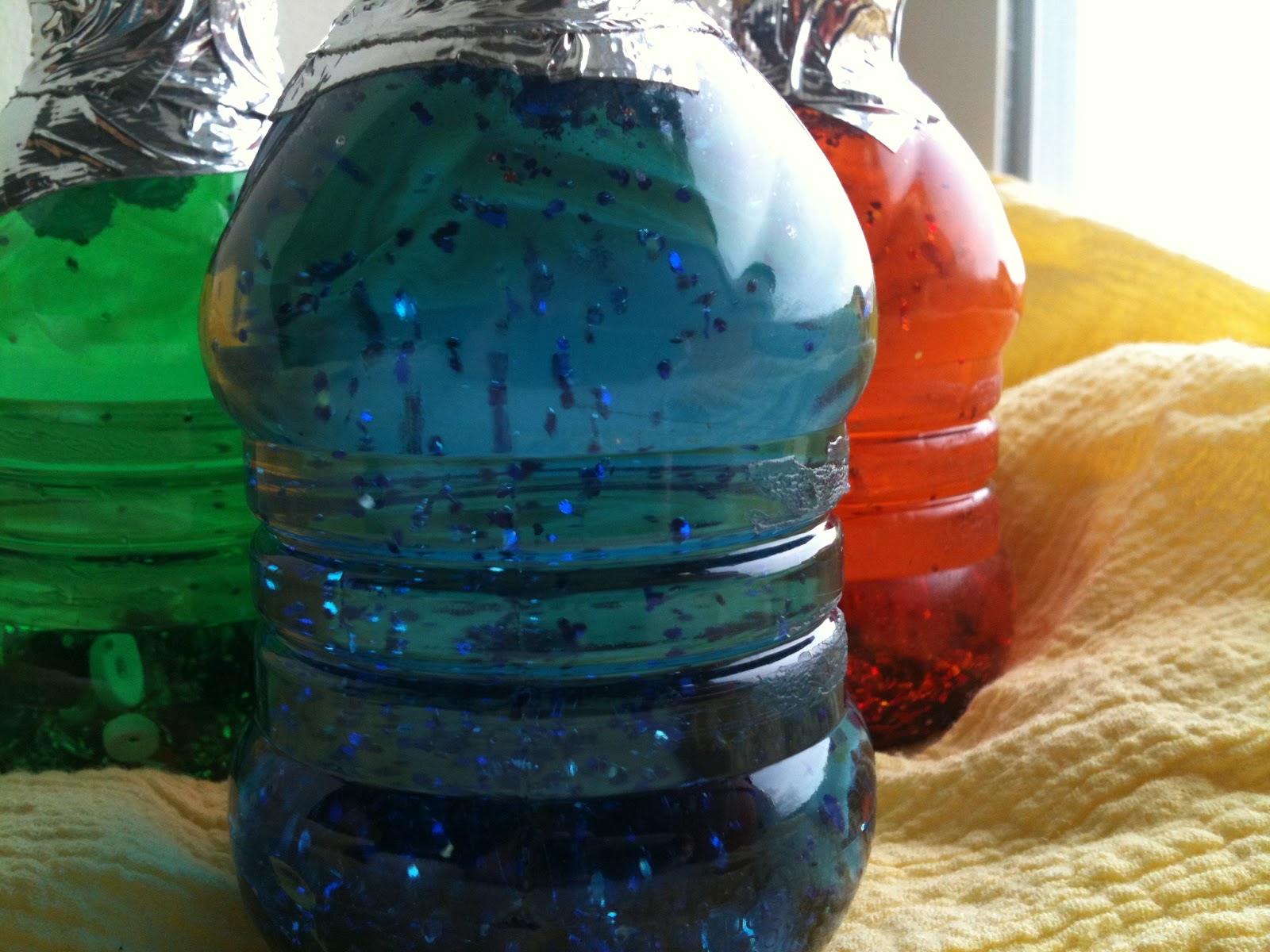
Over the last few weeks, I have been saving and collecting various sizes and shapes of water bottles. I made enough for every student to have one during the latest story dance class. First we read an alphabet book that also features colors. We reviewed the colors before I handed out the shaker bottles. 

With shaker bottles in hand, I led the kiddos through a movement exploration exercise that explored location words - we shook the bottles in front, above, behind, to the side, down low,  and in between our legs! Then, of course, we got to free dance with them. Not only was this a fun, kinetic exploration on spatial awareness, but these words and concepts are also foundational math skills. 

We continued with our math skills at the end of class through bottle color-grouping and matching exercises. I encouraged students to find other students who's bottles were a similar color to their own bottle. For our cool down, I laid out different color felt squares. Then I called on students one at a time to bring up their bottle and put it on the corresponding color square (apparently I need more red bottles!). This part of the class also elicited a great discussion with the children about colors. For example, water in one bottle was a little bit blue and a little bit green - which square should it go on?

Young children are often mesmerized by the swirling objects inside the bottle. The ones I made also include letters of the alphabet, words, and fake fruit! Because the bottles also have some weight to them, the children are getting a good work-out, keeping their bodies healthy and strong while dancing, moving, playing, and learning.


 Making Shaker Bottles!

First, save a bunch of water bottles.


Then, make a trip to the local craft store for supplies - don't forget the food coloring and corn syrup from the grocers.


Then, go to town!


Friday, March 30, 2012

On Being an Expressive Arts Therapist

Since graduating from the degree program where I officially earned my title of "expressive arts therapist," I have had several potential future ETs ask me about the field, wondering if this is the right career path for them. This is often a difficult and exciting conversation to have! In answering them, I reflect on my own path as an artist, educator, and therapist. I also tell whoever I am speaking with that expressive arts therapists are all different - we all bring something different to the work and we all do the work in different ways, in different places, and with different people. My path and my work is not going to look the same as that of another expressive therapist.

I came to the work with the training and education of a performer and teacher. This background shapes my work as an ET and, in many ways, defines it. Another part of my career development is the path I took down the road of early childhood education. In my story, I often mention that being an early childhood educator was never in my plans, but has become as defining to my identity as an expressive therapist as my background in performing arts.

Me conducting a "rumble" with pre-k students in a music instrument circle.

Today,  I have a better sense of who I am as a person, an artist, a teacher, and expressive therapist. Over time, I have developed specialized areas of the work I do; early childhood, autism spectrum disorders, and learning disabilities. I continue to hone my craft as a therapist, educator, and as a (my first love) - performer!

For me, being an expressive arts therapist is the greatest job in the world. I can share my love of performance and the arts while affecting lives - including my own. When I show up to run a story dance group with preschoolers who have speech delays, who have experienced trauma, who struggle with motor skills, and witness a little one light-up and smile when they dance with a scarf, jump to the tambourine, or dance to the music, I know I have made change in the world. It may seem like a such a small thing, but it is so huge, it is bigger than me. Being a part of that, there is nothing more fulfilling. There is nothing more affirming.

That is not to say the road is an easy one, the struggles have been many. As I often say to those who are interested in joining the field, we create our own jobs. This can mean going out on your own - marketing, promoting, traveling, renting space, and all that fun stuff. It can also mean taking a job in another position and bringing expressive therapies to it. When I talk about it, I feel empowered to be a part of this community of people who are still evolving the field. It can also be frustrating and depressing at times, especially when your paycheck may not reflect the value of the work you do.

Despite all the obstacles that one may face discovering themselves as an expressive arts therapist in a field that is still getting to know and define itself, I could not imagine living any other way. If you have passion for the arts and making change in the world, this may be the path for you too.


Friday, December 9, 2011

"Stretch" with the Preschoolers

This week's story dance class with the preschoolers was super fun. We read Stretch by Doreen Cronin and Scott Menchin (also in book recommendations!).  After our warm-up and snake breaths we get ready for the story. I pass out the story squares and as I do, the children name all the colors. Then I review the book cover with them. The first story dance group made spontaneous predictions about what animals they thought would be in the story. It was great. Sadly, the crocodile one child predicted did not appear in the story, but he did not seem disappointed by the giraffe, whale, leopard, and kitten who did.

A page from "Stretch."

After the story, I put on some mid-tempo music and led the group in a story square stretch. I ask them to hold the squares with two hands and stretch the square up, to each side, lunging, we stretched them out front and behind, we shined our shoes with them. Next, I collected the squares and asked the children to sit down for I was bringing out my faithful sidekick - Mr.Tambourine. I went around the circle and had each student tap Mr. Tambourine with their toes. This was a really cute exercise that they all seemed to get a kick out of- ha! I think some of them may have thought the notion of being asked to kick the tambourine with their feet was absolutely absurd.  It is a funny idea considering if they were to go around kicking tambourines, that would definitely not be ok.

It is ok, however, in a structured class as this. The tambourine provided them a focal point to aim, stretch, and tap. The tambourine was a target, and when they toe-tapped the target, they created a really cool sound. This invites an auditory experience along with the kinetic and I like multi-model, or inter-model, experiences in the learning process. This type of exercise is beneficial for developing self-awareness by exploring their bodies in space - My body ends here, CLANG! (or whatever sound it makes). It also helps to develop self-awareness through force; when the student kicks lightly, one kind of sound occurs. When they kick hard, another and more startling sound occurs. This is very valuable information for the developing brain.

My tambourine is also super durable and I use it regularly when teaching dance, movement, and drama, so I wasn't worried about them kicking it.


For our dance party, I passed out the dance scarves and encouraged students to use the scarves in different ways, incorporate some of the stretch  moves we had previously done, and - the best part - throw the scarves up in the air! For this part of class, I put on Groove Armada's If Everybody Looked the Same from the album Vertigo. This song is really up-beat and has a funky groove that they can all get down to. The only lyric in the song is, "If everybody looked the same, we'd get tired of looking at each other." I believe this is a great message in general and totally coincides with my teaching philosophies of acceptance/tolerance/and celebrating diversity. From my years of doing this, I have also learned that little kids really love disco. This song is not disco necessarily, but this song has similar elements that the kids like to boogie down to. After all, we can't listen to Stayin' Alive every week!

Saturday, December 3, 2011

"Peaceful Piggies" Yoga Characters

"Peaceful Piggy" Flann
 The kindergarten and pre-k classes did in fact enjoy the masks. They were a little too big, but we rolled with it. The kids thought they were silly and fun. I would read them a page from the book Peaceful Piggy Yoga by Kerry Lee Maclean (also in book recommendations!), then talk about the peaceful piggy in the illustration. I brought different props to go along with each piggy character. Two students would come up and become those "peaceful piggies" and demonstrate the pose for the class. The format worked really great, especially for the smaller pre-k group. For the larger kindergarten class,  we only had time for half of the book; I will do the second half of the book during our next class.

I brought back the ukulele and did Yoga Freeze Dance for our dance party. I encouraged the students to incorporate movements of the different characters and poses we had explored in the book. The end of class dance party varies each week. Sometimes we freestyle, sometimes we freeze dance with special poses, sometimes we play Magic Soup. The rules of the dance party may change, but I always leave time for the dance party; it wouldn't be story story dance without it!

I have not yet done peaceful piggies with the preschoolers. I think the format will have to be a little different and more contained. I think I will leave out the masks, but use the character props, and have everyone pretend to be peaceful piggies. I am pretty sure this group will be able to get into piggy character without the assistance of a mask. I'm still exploring ideas for this one.

I am also looking forward to the second half of Peaceful Piggies with the pre-k and kindergarten. They all seemed to enjoy taking turns being different characters and getting-up in front of the group.


"Peaceful Piggy" Jack in Tree Pose

Thursday, December 1, 2011

The Hip-Hop Dancing Firefighter

Its days like these that I feel so grateful to do what I do. I get to witness and experience these great moments and when they happen, all I can do is smile and fill-up with joy because I was there.

Today's story dance class was with the preschoolers. I read Eric Carle's From Head to Toe (also in book recommendations) As I read along, the little ones tried out the different moves in the story. After the story, I invited each student up one at at time. They could turn into anything they wanted and had to share a movement for the class. Then I would introduce them in the style of the book, "This is Princess Samantha and she can twirl. Can you?" Then everyone would twirl. Essentially, it is a mirroring game and they were super cute doing it. We had three firefighters, but one of the fire fighters was a hip-hopping firefighter (this was painfully cute, this kid was getting down!). We also had a student who was a  pumpkin that flapped up and down and made a silly noise, and there was also a very deliberate kitty cat that was more like a robot - this kid was committed to his sound and movement like I'd never seen. After everyone got a turn, I put on Groove Armada, and we had a dance party. I invited the kids to incorporate moves from the book and moves of their friends.

It was a pretty great class for everyone. The children's responses certainly had the teachers in smiles and all the kids moving. It was a joy!

Wednesday, November 16, 2011

Integrating "Book Time" with At-Risk Girls

I have a great group of girls for the hour long story dance class.

Last week was our first class together and it went great. For the cool-down at the very end of class, we sat in a circle, and I asked the group of inner city 5-8 year old girls to each tell me one of their favorite books or stories. We went around the circle, the answers were...concerning.

The first response was Justin Bieber. (pause). Do you have a book about Justin Bieber? Yes. (ok well, at least she's talking about a book). Most of the girls when asked this question gave answers that seemed odd,  I think there were more movie references than anything. One girl did have a book of all the princesses. Another girl said that the book we read that day for our class (Dance with Me by Charles R. Smith Jr. - also in book recommendations) was her favorite. I told her and the other girls that any of the books we read in class, they can find at the library (which you can almost see from our building). There was a little bit of an excited buzz that went around the circle.

I wonder what kind of exposure these girls are getting to good books? Who models good reading habits for them? Have they ever even been to the library?

Based on the answers of the previous week, I decided to incorporate "book time" into this week's class. I brought a stack of age appropriate books that I have in my collection and put them out. I was going to save this as an end of class activity, but they were so excited to see the books, they just picked them up and started looking at them, reading them, and asking me and the staff person to read. So instead, I set the timer for five minutes, and told them when the timer goes off, we will put the books away and start our warm-up.

I love that a major part of my job is to get kids excited about reading.

It was working with at-risk girls like these and recognizing the need for more exposure and opportunities with literacy that got me to start incorporating more and more literacy into my dance classes. Now it has become a class of its own and the format seems to work really well. I like, and I believe the kids also like, having fun kinetic experiences with language and literacy. There is also music, and instruments that come out sometimes, we write words on the board, and look at the pictures in the book, sometimes the girls read the story along with me. Story Story Dance! has all the learning styles covered.

Book time is now an official part of this class for my girls group. I am so glad I decided to bring all the other books. It was a last minute on a whim thought. The books were already in the backseat of my car not doing anything, so I grabbed a bunch and brought them in with me.

Sunday, November 13, 2011

Preschool Pretzels

I ran the story class for My Daddy is a Pretzel with the preschool groups which went very well. I am always a little unsure of how things are going to go with such a young group, but they surprise me each week with their enthusiasm and ability to stay engaged and on-task. Just like with the older kids, we practiced our snake breath, did our warm-up, and had a pre-reading discussion about jobs. This was actually funny. The best answer for what job does your mommy or daddy do? - "fire truck."

Then we read the book. On the first page of the story, the illustration shows the kids sitting on colorful squares, a bunch of them piped-up "story squares!" Each week I pass out different colored felt squares called "story squares" to help keep the children in place during the story. They were very excited to see themselves  reflected in the book. We read the book and tried out moves in our own way on our story squares - similar to the other groups. For pretzels, I had them all get twisty in their own way.

Then we practiced the yoga poses standing up for "Yogi Says" and closed the group with the yoga dance party. They loved my green ukulele, which is becoming such a wonderful teaching tool, and it is so light and easy to transport. We played a variation of "freeze dance," when I play - you dance, when I stop - yoga pose. They did great with this. I made sure to call out all the different poses I saw, "I see a triangle, I see a tree, I see a bridge!" This was helpful to get all the kids participating and trying out different poses.

One little guy was stuck on doing the lion pose and roaring at everyone, but once I started giving out the verbal attention, then he started trying new things. They all want to be noticed. Every class from preschool to kindergarten, they all say it "watch me!" It's cute and adorable, and they all do it, from the east to the west.

The very last class ending pose was the rainbow pose. I have seen different versions of poses with this name, but what I had them do was lie down on their backs, relax, and look up into an imaginary sky with big white fluffy clouds going by - can you see them? Now look for the rainbow - can you see it? As the kids are lying down calmly and quietly, I pass out stickers, releasing them to their teachers.

I try not to do stickers for every class. I want stickers to be a surprise at the end. For years, I didn't give out anything at the end of each class. I would wait until the final class to give each student a participation certificate - which they all love to get. It took me years to get over it and that stickers are ok. I was concerned that kids would lose the intrinsic value of the class and get too focused on stickers. This has not been the case. Even on the days where I don't (or forget or run out of time) to give stickers, I don't hear any complaints. They don't notice, because, I think, they just had a lot of fun and are leaving the group happy. So now, I have three booklets of stickers I keep in my Mary-Poppins-Like tote bag (along with scarves, tambourine, bells, a toy microphone, felt squares, and anything else I may need). It is good to keep things with you even if you don't plan on using it, sometimes, in the moment, you many need a plan B, or C, or D.

Tuesday, November 8, 2011

Yogi Says, Yoga Dance Party!

Today I had so much fun with the kindergarteners and pre-kers for Story Story Dance! The story of the day is My Daddy is a Pretzel by Baron Baptiste (also listed on the Book Recommendations page). I also used yoga visuals from the Yoga Pretzels Yoga Cards (these cards are great, I incorporate them into these classes whenever I can). After the warm-up, we sat in our story circle and discussed the book cover. Then,  I informed the children that the children in this story share the different jobs their moms and dads have. We then engaged in a discussion about jobs, or occupations and they shared the different jobs they knew or the one's of their parents. My favorite (and the most common answer) was "they work."

Some children did in fact have parents who were "construction workers" an "architect" and "baker," like some of the children in the story. As we read along, we tried some of the poses. During story time,  I limit movements to those we can do on our story mats (no standing activities). While on our story mat for this book, we made tree arms, we made triangles with our hands and fingers, airplane arms, fish faces, made pretzels with our arms by making them twisty, and stuck out our tongues for lion pose.

The next half of the story dance class emphasizes axial (on the spot) and locomotor (through space) movement.  We practiced triangle pose, tree pose, and mountain pose and played a round of "Yogi Says." For our end of class dance party, I busted out my ukulele and we played Yoga Freeze Dance! The is a new instrument for me and I am loving how fun it is to play and how easy it is to tote around (mine is a vibrant green with a sheen).  While I played a tune, the children danced around. When I stopped and held the ukulele up over my head, they got into any yoga pose that we practiced during class. They seemed to have a lot of fun with this and it was interesting to see which poses they chose. For our very last pose, everyone laid down on their backs and pretended to be peaceful rainbows. A great ending.

Today's classes were super fun. Story, children, yoga, and the ukulele go very well together.

Saturday, November 5, 2011

Jump, Stomp, and Roll with the Preschoolers

This week I led the autumn leaves class with the preschoolers. I modified the class slightly from the pre-k and kindergarten class. For the little ones, I called them up one at a time to jump over the leaves, stomp on the leaves, and the best part - roll over the leaves! It was really super cute and both preschool classes thought it hysterical when the leaves would stick to their own or their friend's clothes. Like the other classes, we ended with a leaf dance party.

Every time I do classes with the leaves, there is an overwhelming expression of joy when they are gathering up leaves and throwing them up in the air to music.

I remember in my neighborhood growing up, all the neighborhood kids would get together to rake leaf piles and then we would catapult ourselves into them. We would go from one backyard to another. I haven't jumped in a real leaf pile in probably over 20 years (sadly), but it is one of those joyful childhood experiences that stays with me. I think the child in me gets to come out and play with my students when we dance with the leaves and we all just feel, well, happy.

Wednesday, November 2, 2011

Autumn Leaves and Movement

Every fall, whatever version of creative movement I am teaching, I have to bring in the fall leaves. I do not use real leaves, they are too messy, I have these really nice cloth leaves in great fall colors - and they are long lasting. For the story dance class, I searched for a fall book about leaves that had great action words for the kids. When visiting a first grade classroom recently, I came across Autumn Leaves are Falling Down by Maria Fleming, (more on it in Book Recommendations). This book is full of actions the kids can do -and we did.

The kindergarten group was my first group today. After the warm-up and passing-out story squares, we talked a little about the book and I invited them to try out the actions in the story on their squares.  The story starts with leaves falling down; without any prompting from me to do this, they starting lifting their hands above their heads and made motions with their hands like leaves falling! I love when they do things that I don't expect them to do; these are the wonderful surprises of teaching.

After the warm-up and the story - before the class concluding dance party - I ask students to line-up behind the "start square"  (and show them where to end their turn, the "end square"). Each student took turns leaping over, creeping around, stomping on, and then rolling through the leaves. They loved this. Not only were students kinetically connecting with the language in the story, but by incorporating place language -on, over, through, under, above, between, in front of, behind, and so on -  into movement, students also have a kinetic experience with foundations of mathematics.

To end the class, we go over safe dancing rules - which includes getting to throw the leaves up and letting them fall (also in the story). They enjoyed dancing to the tambourine, free-styling, and bringing back moves from earlier.

There were a lot of smiles today. They even saw cleaning-up all the leaves and putting them back in the bag as a treat; I didn't even ask, they just started doing it! They also seemed unmoved by the fact my speakers weren't working today, so I improvised with my tambourine. When I have the kids do leaps in class, I usually take it out and shake it dramatically, then SLAP it when they are midair, leaping over whatever it is they are leaping over - today that was leaves ( it's very exciting). Since the speakers were barely audible, I continued with it to finish the class. No one seemed to mind. They were pretty excited to dance in the leaves.

Sunday, October 30, 2011

"Old Lady" Props with the Preschoolers

Last week I ran the Story Story Dance! class with the preschoolers and it went surprisingly well.  The class sizes were much smaller than the kindergarten group, which I think just works better, about 10 students. When it got to be that time in the class to start handing out the props that go with "The Little Old Lady Who Was Not Afraid of Anything" by Linda Williams,  I handed the props to two students at a time and called them up to do the movements; the rest of the students mirrored their movements from their story squares. Next,  I did something I did not do with the other two classes - I took back the props after they were done and lined them up in front of me on the floor in the order they appeared in the story and the students rejoined the group in the half circle.  Though I have double of everything, I would put out one of each to go along with the story, and put the second matching prop away. Each time the story reviewed all the clothes and their corresponding movements, I would point to, or pick up the prop, and the students did (and said) the movements from their story squares. This worked great. I was not sure how this was going to work with the little ones, but laying the props out as we went along was really the way to go. And after the story - monster mash dance party!

I have been writing a lot about this book and the props because these were my first classes using the book this way.  For me, trying something new is kind of exciting because I really have no idea what's going to work, how the children will respond, or if they are going to like it at all.  I knew that they would like all the little props, but did not know at the start which way would be the best way to incorporate them.  Sometimes the best way to plan for something is not to plan, but to let things happen. That is the approach I took with this. Each class experienced the story and props in a different way, no one cried, no one got hurt, and I think most of the students (who knows maybe all of them) had fun.

Tuesday, October 25, 2011

First Class

Today I led my first groups integrating the props into The Little Old Lady Who Was Not Afraid of Anything by Linda Williams. My first group was 18 kindergarteners, a pretty big group. After doing our snake breath and warm-up,  I passed out the story squares and all the props. I was short two. In an instant, I had to turn this moment into something amazing or else things could turn very badly very quickly. Aha! They are going to start the story.

I walked them away from the group of students sitting on their story squares with their props in hand. They would start the story by tagging the students who have the baskets (they were they old ladies). The story opens on a windy day, so my story starters turned into the wind and blew themselves over to the group and tagged the next two students in the story. In the story, the old lady gathers spices and herbs; these students acted this out in the center of the group. Then, they tagged the students with shoes, then those students tagged the students with the shirts, and so on until everyone had a turn.

It worked!

Nobody got upset about not having a prop - phew! This is a moment that could have gone so horribly wrong."Story Tag" happened as a response to a possible child meltdown that instead became the spark for the rest of the class.

The next group to come in was the pre-k and they are a much smaller group. They sat in more of a semi-circle to me which I think works better for using the props. These students came right up on their turns, made their props dance as well as danced themselves, and were visible by everyone and everyone could still see the book. The kindergarteners sat in a circle. Dancing and moving inside the circle got crowded at times, and made the book hard to see for students in the outer circle. None of them seemed to mind, but I will try the semi-circle method with them next time I do props.

After we did the story, I ended each class with a monster mash dance party. I played them the old tune by Bobby "Boris" Pickett & the Crypt-Kickers. The best spontaneous thing that happened was when the kindergarteners formed their own conga line and made it go around in a circle. Pretty awesome. I thought that was great. When the pre-k kids attended their monster mash party, they did not make a conga line, but they sure had a lot of great monster moves.

Today was a really fun first time trying something new. Next time, preschoolers...

Saturday, October 22, 2011

Props and Inermodel Learning

I gathered and also made props to accompany my telling of the Little Old Lady Who Was Not Afraid of Anything by Linda Williams. Students will act out the appropriate movements that appear in the story and match the various props. I have doubles of everything that the little old lady encounters so that I can give more students more turns during our short time together - with a few exceptions. I found a pack of six plastic jack-o-lanterns, which also happen to look just like the one in the story. My husband sculpted one pair of shoes using air dry clay; it being a pair, two kids can get a turn at the same time. Missing from the photo is my little scarecrow on a stick that I found at a crafts store for the ending. I may go hunt down a second one, I haven't made up my mind yet. I also have a prop to represent the old lady, two adorable baskets. The top hats are wearable and the gloves are child sized. It is a little hard to tell in the photo, but the shirt sleeves and hems are also fringed like the pants. What can I say, my scarecrows dig fringe.

This is one of my favorite books to teach with. I love when authors choose language that invite movement. I want to capitalize on that in my Story Story Dance! classes. The props provide students with another opportunity to connect with language. This class incorporates tactile, kinetic, visual, and auditory learning experiences, which means increased chances of reaching more learners.

Friday, October 21, 2011

Wiggle, Wiggle, Shake, Shake

Next week I will be reading one of my favorite books (also listed on my recommendations page),  "The Little Old Lady Who Was Not Afraid of Anything" by Linda Williams. I will be sharing the book in my classes next week for Story Story Dance! This will be my first time incorporating props to tell the story. I went on an adventure today to gather up what I need, a process which lit up my creative synapses. I have a plan for incorporating the props, the story, and the dancing, but since this will be the first time doing it this way, it will be exciting to see how this all unfolds.
I love the creative process I experience when I am creating my classes. I enjoy the challenge of bringing all the elements together and trying them out, and seeing the kids get excited about participating.  That's really the best part.

Thursday, December 30, 2010

Magic Wands

Magic wands are extremely helpful when teaching young children. You can also use magic bells... magic anything really. And the best part about them, is that they work! For my creative movement preschool program, I use an earth bell and refer to it as the magic bell. When I ring it, everything freezes.  Silent signals are extremely useful with this age group and all age groups really. Calling it magic is what gives it its power. The children make it work.

I start each creative movement class in a circle. I do a check-in at every circle to help students get focused and prepared for the class which requires a lot of listening and following directions. During this check-in, I look at each student directly making eye contact with them, then I roll them a ball. The rule is only the person with the ball can talk. I ask everyone the same question, and they roll the ball back to me after they answer. For initial groups this exercise also helps me learn everyone's name. In later groups, I may ask questions like what is your favorite color?food? After the check-in, I bring out magic bell. I ask the students to help me check if magic bell is working today. If magic bell is working, then we can have class. If magic bell is not working, we cannot have class. I ask everyone to wiggle and shake (they love this). When I hit magic bell, they freeze.

With one group, students were getting a bit over excited with the movement activity, this is what magic bell is for - behavior management. I ring the bell so that everyone will freeze; but on this day, they keep going. I rang it again, but the children still did not freeze. Then, I turned off the music and said, "Oh no! Magic bell is broken! We have to end class." The children look stunned and disappointed. I ask them, "should we try magic bell one more time?" They say yes. Then, like I check at the beginning of class, I ask them to wiggle and shake, I ring the bell, and they freeze. We have not had any issues with magic bell not working in this class since.


I also used magic wands in my preschool creative movement class for our Nutcracker inspired classes. We galloped pretending we were reindeer pulling a sleigh to the Sugar Plum Fairy's palace follow-the-leader style. I led the students all around the space eventually ending the exercise with everyone sitting on the mats facing the dance space. For this performance score, some children pretend to be the "honored guests" while students take turns being the various dancers from the Land of the Sweets. I pass out magic wands (straws with sparkly ribbon coming out held together with a staple covered by big sparkly snowflake foam stickers). The dancers were given a palate of twirling, sliding, and pointing for the Sugar Plum Fairy dance. I demonstrated the dance moves they could play with and turned on the music; then one of students (four years) said, "It's light and airy." Yes it is! What I also love about the magic wands is that there is no gender preference; boys and girls in all three classes were equally excited and expressive with them as well as with scarves as the Arabian dancers.

The next class after this one was their final class of the eight week creative movement program. When I rolled the ball to each student at the start of class, I asked them to tell me a dance, game, or exercise, anything we have done in class, that they would like to do. They would be designing the final class.

All three classes asked for the wands and the Red Carpet game. What great feedback.

Thursday, December 23, 2010

Trying Something New

Often times, you can plan and design what you think is an amazing lesson (or program) that your students will have a great time with, and it goes okay but not great, but the thing that you made up on the spot with just what you had around you, is the most creative innovative program that draws the most excited responses from students. And sometimes you can plan something, then actually get to implement it, and have it actually work. Those times are awesome.

Saturday, December 18, 2010

12 Kids-A-Leaping

Every year around this time, I find some way to integrate music from Tchaikovsky's The Nutcracker. The music offers wonderful inspiration for creative movement classes for children and adolescents. This past week in the preschool creative movement class, I introduced Nutcracker music to the students for leaps over the "snow" (batting). For young students, they don't need much to jump over to get them actually jumping, something as simple as colorful tape stuck to the floor can be all they need to encourage a jump. I like to make a story out of the exercise, or some guided imagery, turning the props and the activity into something exciting. I told the students that the batting is the snow and they are the leaping reindeer. I also told them how I was a reindeer in the Nutcracker when I was five; clearly the experience has been inspiring!

When leading exercises for children this young it is absolutely necessary to show them where to start and where to finish their turn. I put a large foam square puzzle piece on the floor - this is the start. Then I demonstrate how to run and leap over the batting. The child's turn is finished when they return and sit back down on the mats. I crank up what a former student referred to as "the big song" and stand on the side with my tambourine. As each child leaps over the batting, I hit the tambournine! This adds drama and excitement and the kids love it.

During the winter months, I have a lot of fun creating classes using the batting and other white fabric or tulle as props to encourage movement in the children who are natural performers and for who play is their language. For children who struggle with imagintive play - and there are children who do - the props can be their way in.